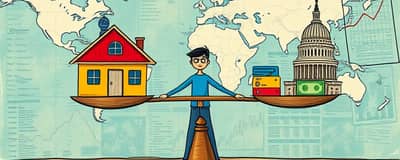
In recent decades, the gap between the richest and the rest of society has widened with striking speed. As economies grow, the lion’s share of gains has gone to an ever-smaller group. This article explores what drives these divides, how they play out globally and in the United States, and practical steps to build a more inclusive future.
Defining Wealth and Measuring Inequality
Wealth disparity refers to the uneven distribution of financial assets and net worth among individuals, households, or groups. Unlike income, which represents a stream of earnings over time, wealth captures the total of assets such as real estate, stocks, pensions, business equity and savings minus liabilities like mortgages and loans.
Economists rely on several key metrics to gauge inequality:
- Gini coefficient: A scale from 0 (perfect equality) to 1 (complete inequality)
- Top wealth shares: Percentage held by the top 1% and top 10%
- Intergroup gaps: Differences in net worth across racial, ethnic or income tiers
Across most nations, wealth is more unequally distributed than income and tends to persist across families, fueling persistent gap across generations.
Global Landscape of Wealth Disparity
Worldwide, certain countries exhibit stark inequality, while others maintain relative balance. High-income nations like Norway and Finland enjoy low Gini scores, but many middle- and low-income countries show extreme disparities.
Data from global research institutions confirm that the top 1% capture most wealth growth in recent decades, while the bottom half of the world’s population holds only a small single-digit share. In 2024 alone, billionaires saw their fortunes swell by roughly $2 trillion, even as many families struggled with rising living costs.
Wealth Inequality in the United States
The U.S. illustrates how wealth gaps can widen rapidly. Since 1980, the income Gini rose by about 20%, while wealth inequality accelerated even faster. From 1983 to 2016, the share of total household wealth held by upper-income families jumped from 60% to 79%.
Within income tiers, the divide deepened:
- Upper-income families saw median wealth increase by 33% from 2001 to 2016.
- Middle-income households experienced a 20% decline in median net worth.
- Lower-income families suffered a 45% drop, leaving them more vulnerable to economic shocks.
Today, the richest 10% of Americans own roughly two-thirds of total household wealth, while the bottom 50% hold only a small fraction. The ratio of wealth between the top 5% and the middle quintile has more than doubled since 1989.
Economic Undercurrents Driving Wealth Gaps
Multiple structural forces contribute to widening divides. Understanding these “undercurrents” is vital to crafting solutions:
- Labor markets and productivity: Productivity has outpaced median wages, shifting gains toward corporate profits and top earners.
- Higher returns on capital: Assets like stocks and real estate deliver superior returns compared to wage income, compounding advantages for those who already own them.
- Tax and fiscal policy: Lower effective rates on capital gains and inheritances enable wealth accumulation at the top, while underinvestment in public services limits opportunities for low-wealth households.
- Education and skills: Unequal access to quality schooling and training perpetuates gaps in earning power and wealth building.
- Discrimination and historical bias: Practices like redlining, wage gaps and exclusionary policies have left lasting racial and gender wealth divides.
Social Consequences and Paths Forward
High wealth inequality undermines social cohesion and economic stability. Nations with extreme divides often see reduced upward mobility, weaker consumer demand, and heightened financial fragility leading to booms and busts.
Addressing these challenges requires coordinated action at multiple levels:
- Policymakers can enact progressive tax reforms on high-value assets, strengthen estate taxes, and expand public spending on education, health and housing.
- Communities and businesses should invest in apprenticeships, mentorship programs and affordable credit to empower underrepresented groups.
- Individuals can build personal resilience by pursuing lifelong learning, diversifying income streams, and advocating for transparent corporate and government practices.
Conclusion
Wealth disparity may seem a daunting force, but history shows that policy choices and collective action can reshape economic outcomes. By recognizing the root causes of inequality, legitimizing informed debate, and embracing inclusive innovations, societies can unlock broader prosperity.
Each stakeholder—governments, corporations, communities and individuals—holds a piece of the solution. With deliberate reforms and shared commitment, it is possible to bridge divides, foster opportunity, and create a more equitable world for future generations.