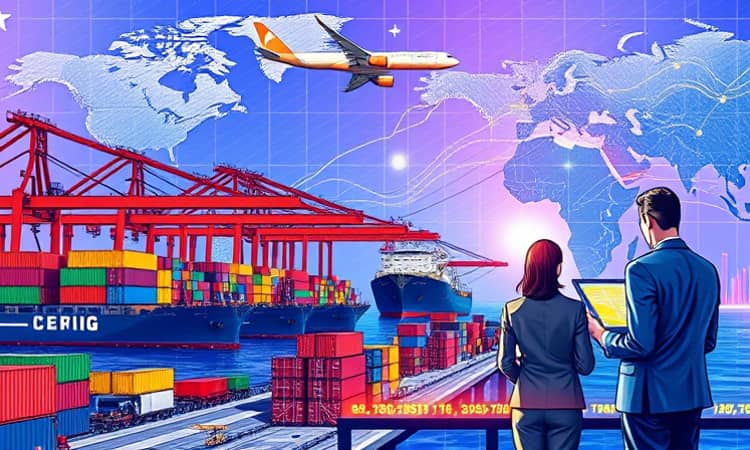
In an era of shifting alliances and economic complexities, understanding trade policy is no longer optional—it’s essential. Businesses of every size must navigate tariffs, trade restrictions, and evolving market dynamics to maintain competitiveness and achieve growth. This article dives deep into the latest data and trends from 2025, offering practical insights and strategies to help companies thrive.
Global Trade Trends and Projections
Despite geopolitical tensions and policy shifts, global trade expanded by about $500 billion in the first half of 2025, according to UNCTAD. Goods trade grew by 2.5% quarter-on-quarter in Q2, a slight acceleration from Q1’s 2%, while services trade rebounded sharply after a contraction earlier in the year.
On an annual basis, goods trade is up around 5% and services trade by approximately 6%. UNCTAD’s nowcast predicts another 2.5% quarter-on-quarter increase for goods and 4% for services in Q3. Barring major disruptions, 2025 is poised to surpass 2024’s record in global trade value.
However, longer-term forecasts are more cautious. The World Bank has revised its 2025 global trade growth projection down to 1.8%, less than half the two-decade pre-pandemic average of 4.9%. The WTO maintains a slightly higher 2.4% growth forecast for merchandise trade, driven largely by short-term factors such as frontloading.
Key Drivers of Trade Growth in 2025
The drivers behind this resilient expansion are diverse, but manufacturing is the main driver—electronics lead the charge, followed closely by hybrid and electric vehicles boosting the automotive sector. Additionally, trade in AI-related goods surged 20% in H1 2025, reflecting soaring demand for semiconductors and servers.
- Frontloading of imports into North America as firms anticipated tariff hikes
- Strong South–South trade growth in developing economies
- Rising prices for traded goods contributing to volume and value increases
This combination of higher volumes and rising prices is expected to sustain momentum into Q3, even as businesses brace for potential policy reversals.
Tariffs and Policy Shifts: A Closer Look
A decade-long rise in trade restrictions accelerated sharply in early 2025, with advanced economies responsible for nearly 70% of new measures since 2022. The United States’ new tariffs have generated $88 billion in revenue year-to-date through August, but at the cost of significant market distortions.
U.S. imports from China collapsed to half their value by May 2025, and goods import volumes plunged nearly 20% month-on-month in April. Meanwhile, global companies have revised down their expected U.S. tariff costs from over $35 billion to about $21–23 billion for 2025, and to roughly $15 billion for 2026, thanks to new trade deals and clearer regulatory guidance.
Regional Dynamics and Trade Imbalances
Shifts in U.S. policy have narrowed global imbalances in goods trade in Q2. However, trade deficits expanded in Japan, India, and the United Kingdom, while China’s surplus with the U.S. declined notably. The EU also saw a reduction in its trade surplus, underscoring the broad impact of tariff measures.
Sectoral Exposure and Industry-Specific Impacts
Manufacturing firms, particularly in computer and electronics, face the highest exposure. Inputs for these firms often exceed 20% imports, leading to an estimated 3.5% increase in input costs. Automotive and electronics supply chains remain vulnerable to disruptions and cost pressures.
- Energy sector: lower import exposure but profit margins are highly sensitive to even modest cost increases
- Construction, mining, utilities: nearly 22% of firms expect hiring declines due to tariffs
- Retail and wholesale trade: about a quarter of firms forecast hiring decreases
SMBs on the Frontlines: Challenges and Responses
U.S. small and medium businesses bear disproportionate burdens. Direct tariff costs estimated at $85 billion annually translate into higher compliance hours, customs broker fees, and lost duty-free advantages. Small firms expect sales nearly 9% below normal, compared to a 3.5% dip at larger firms.
Employment data from ADP shows a fifth consecutive monthly decline in private employment among small firms, while larger companies continue hiring. Tariff uncertainty—tariff uncertainty is closely linked to investment, employment, and profit margins—exacerbates planning challenges for importers.
Strategic Adaptations for Uncertain Times
Amid rising policy risk, businesses must be proactive. More than half are planning to diversify supply sources and markets to mitigate tariff shocks. Other key strategies include:
- Diversify supply chains and markets to reduce dependency on single sources
- Invest in digital trade and logistics platforms for greater visibility
- Engage in industry lobbying to influence policy clarity and stability
- Adjust pricing and contract terms to share cost pressures with customers
By implementing robust scenario planning and embracing flexible procurement, companies can transform uncertainty into competitive advantage.
Concluding Thoughts: Navigating the New Trade Landscape
The evolving trade policy environment presents both challenges and opportunities. Firms that understand the data, anticipate policy shifts, and adopt agile strategies will not only weather the storm but emerge stronger. In a world where frontloading of imports boosted growth this year, the next leap forward belongs to those who can innovate supply chains, harness technology, and build resilient global networks.
As 2025 unfolds, decision-makers must stay informed, stay flexible, and see trade policy not as a hurdle, but as a catalyst for strategic transformation.