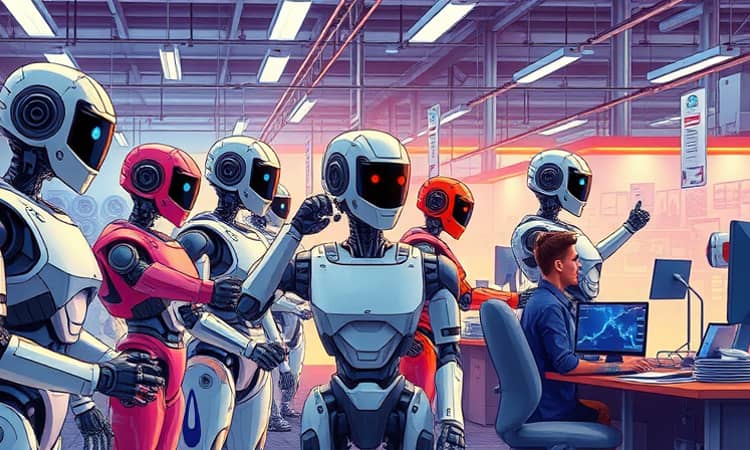
The rapid ascent of robotics technology is reshaping industries, labor markets, and societies across the globe. From sprawling factories to hospital wards, robots are no longer confined to science fiction—they are powerful drivers of economic transformation. This article explores the scale and trajectory of robotics growth, the productivity and macroeconomic value they deliver, the labor market upheaval they trigger, the uneven distribution of impacts, and the strategic opportunities ahead.
Scaling the Robot Revolution
Over the past decade, the robotics industry has witnessed unprecedented expansion. According to recent projections, the global robotics market is about US$50 billion in 2025 and is poised to climb to US$111 billion by 2030 at a remarkable ~14% CAGR. Much of this growth is fueled by the rise of service and mobile robots.
In fact, mobile robots account for more than half of total robotics revenues, with their market value jumping from US$30 billion in 2025 to US$75 billion by 2030 (16.5% CAGR). Meanwhile, the industrial robot segment is growing more modestly, from over US$17 billion to US$19.6 billion in the same period (2% CAGR), indicating a shift toward more flexible, software-driven applications.
Installation trends reinforce this momentum: global robot deployments in factories have roughly doubled over ten years, with unit installations expected to reach 575,000 in 2025 and exceed 700,000 by 2028. As prices fall—for example, cobot unit costs dropping from US$32,357 to US$27,714—broader adoption becomes economically viable for small and mid-sized firms.
Productivity Gains and Economic Value
The integration of robots and AI agents promises to unlock trillions in economic value. McKinsey estimates that by 2030, AI-powered agents and robots could generate about US$2.9 trillion in the United States alone under a mid-level adoption scenario. Globally, the combined automation potential rises to US$28.7 trillion.
- 78% of organizations reported AI usage in 2024, up from 55% in 2023.
- Global AI investment reached US$252.3 billion in 2024, including US$33.9 billion in generative AI.
- Industrial robots with AI capabilities can reduce factory accidents by up to 25%, boosting safety and output.
Firm-level analyses reveal that every doubling of robotics deployment tends to reduce production costs and improve product quality. For vendors, this translates into stronger sales pipelines; for adopters, enhanced competitiveness in global markets.
Labor Market Disruption and Transformation
The flip side of these productivity gains is labor displacement. Since 2000, automation has directly cost 1.7 million jobs in U.S. manufacturing. Globally, estimates suggest that 75–375 million workers worldwide could be displaced by automation by 2030, representing 3–14% of the labor force.
Empirical studies highlight the consequences: for every additional industrial robot per 1,000 workers, employment falls by roughly 0.2 percentage points and wages dip by 0.42%. Some research shows an average of 3.3 jobs lost per new robot, while others find up to 6.2 displaced workers in the United States.
Automation risk is unevenly distributed. Routine, low-skill roles face the highest exposure:
- 25% of U.S. jobs are at high risk (≥70% of tasks automatable).
- Another 36% at medium risk (30–70% automatable tasks).
- 36 million U.S. workers identified as highly exposed to automation.
Distributional and Regional Impacts
Beyond aggregate numbers, robotics reshapes social and regional dynamics. Between 1993 and 2014, industrial robots reduced employment by 3.7 percentage points for men versus 1.6 for women, narrowing but also distorting gender gaps. Non-white workers saw a 4.5-point reduction compared to 1.8 points for white workers, exacerbating racial disparities.
Spillover effects deepen the challenge: when manufacturing jobs vanish, local spending contracts, triggering service-sector losses in retail, hospitality, and transportation. These indirect impacts often hit minority communities hardest and can lead to long-term economic decline in manufacturing hubs.
- Robots can shrink local consumer spending, reducing service demand.
- Displaced non-white workers are more likely to exit the labor force entirely.
- Increased robotization has been linked to workers reporting their jobs as less meaningful.
Charting a Path Forward: New Opportunities, Policy, and Strategy
Despite disruption, automation also creates roles: WEF-style projections suggest 58 million net jobs from automation, as 133 million new positions emerge to offset 75 million losses. Capturing this upside requires proactive policy and strategic action.
- Invest in lifelong learning and reskilling programs for high-risk occupations.
- Develop social safety nets and wage insurance to cushion transitions.
- Encourage public-private partnerships to pilot inclusive automation initiatives.
Governments and business leaders must collaborate to align incentives: R&D tax credits for firms that retrain workers, grants for regional innovation clusters, and standards for ethical robot deployment. At the enterprise level, companies can adopt human-centered automation, using robots to augment rather than replace human talent.
By balancing disruption with opportunity—through education, regulation, and strategic investment—societies can harness robotics to boost productivity, create new industries, and elevate living standards. The choices made today will shape whether the robotics revolution becomes a force for broad-based prosperity or entrenched inequality.