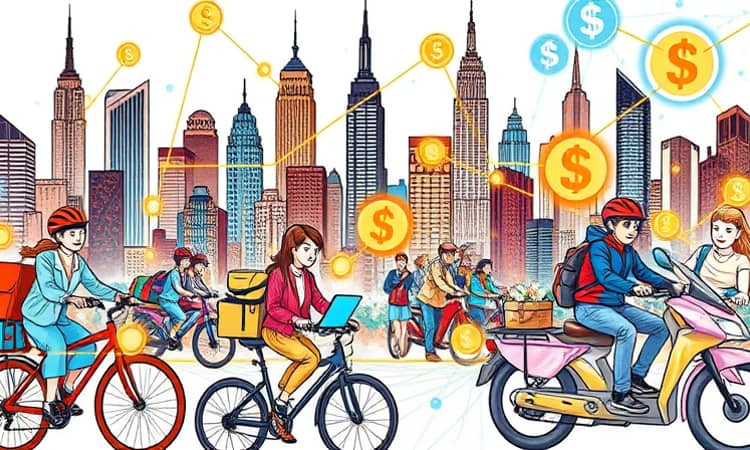
For workers, businesses, and policymakers alike, the gig economy has emerged as a core, fast-growing segment of global labor. It spans rideshare drivers, delivery couriers, online freelancers, and independent contractors, reshaping how people earn and how capital is allocated.
Touching anywhere from 10% to 36% of workers depending on definitions, this market generates hundreds of billions to trillions of dollars in annual revenue and redefines the boundaries between employment and entrepreneurship.
Definitions, Scope, and Measurement
At its heart, the gig economy rests on short-term contracts and freelance work, often mediated by digital platforms such as Uber, DoorDash, Upwork, and Fiverr. Yet it also includes offline independent contractors—construction subcontractors, real estate agents, personal service providers—and solo businesses without employees.
- Platform-based gig work (Uber, DoorDash, Upwork, Fiverr)
- Offline independent contracting (construction, personal services)
- Nonemployer firms (solo enterprises without paid staff)
- Side hustles versus primary income streams
Measuring participation is inherently political and analytical. Depending on studies, gig engagement can range from 16% to 36% of the workforce. Some research counts only platform workers, others include anyone with non-W-2 income. Point-in-time surveys may understate irregular, part-time gigs; longitudinal tracking can capture multiple simultaneous gigs per individual.
Scale, Growth, and Macroeconomic Weight
Globally, platform-driven gig revenue stands between $455 billion and $646 billion, growing at roughly 16–17% annually. When you include broader freelance and independent work, estimates suggest global gig revenue estimated at $3.8 trillion each year. Platform gigs alone engage about 12% of the world’s workforce.
In the United States, more than 70 million Americans—around 36% of the workforce—participated in some form of gig work in 2025. Full-time independent contractors more than doubled from 13.6 million in 2020 to 27.7 million in 2024. By 2027, freelancers and independent workers may comprise half of the U.S. labor force, with projected earnings of $1.3 to $1.5 trillion.
These earnings account for roughly 5% of U.S. GDP—on par with entire sectors like construction or transportation. Within this expansion, the freelance-platform segment alone is set to jump from $5.6 billion in 2024 to $13.8 billion by 2030.
Geographically, states such as Florida lead with 22% of workers in gig roles. Industry concentrations include transportation and delivery, personal services, creative and knowledge work, professional consulting, and online retail micro-entrepreneurship.
Who Does Gig Work and Why?
Participation patterns reveal a diverse cast. Federal Reserve data shows 13% of Americans earn by selling goods on marketplaces, 9% by performing short-term services like rideshare driving or delivery, and many combine these gigs with traditional employment.
Demographically, younger workers, immigrants, and people of color are overrepresented on certain platforms. Meanwhile, highly skilled professionals dominate the higher-paying corners of online freelancing.
Platform companies tout flexibility and be-your-own-boss framing, casting gig work as entrepreneurial freedom. Yet surveys and qualitative research highlight a different reality: many pursue gigs out of economic necessity—to make ends meet, pay debts, or juggle care responsibilities.
For some aspirational entrepreneurs, gigs provide capital, experience, and market access. For many others, they serve as a buffer against wage stagnation and unpredictable shifts in demand.
These tensions reflect a deeper divide between idealized entrepreneurial rhetoric versus economic necessity, reminding us that “choice” in the gig world is often constrained by broader labor market dynamics.
Working Conditions and Precarity
While some independent professionals command six-figure incomes, a large base of gig workers faces irregular hours, unstable pay, and technical hurdles. On average, independent contractors work about 85 hours per month, short-term W-2 gig workers about 88 hours, compared to 155 hours for traditional employees.
At the high end, around 4.7 million independent workers now earn over $100,000 annually. At the low end, EPI surveys find 14% of gig workers earn below the federal minimum wage on an hourly basis, and 29% below their state’s minimum if classified as employees. Those underpaid face a median underpayment of $2.17 per hour, translating to roughly $3,400 in lost earnings annually.
Technical issues compound precarity: 62% of gig workers lose earnings due to app glitches or clock-in problems, compared to 19% of traditional service workers. Over one-third experienced such losses three or more times, while 31% struggled to pay utility bills in a given month.
High turnover underscores dissatisfaction: more than 55% plan to leave gig work within three months, versus 36% of standard service employees. This bifurcated market highlights a small cohort of thriving independents alongside a vast underpaid, unstable workforce.
Labor Rights, Classification, and Regulatory Struggles
Platform companies often classify workers as independent contractors to reduce payroll taxes, avoid benefit obligations, and shift risk onto individuals. This strategy saves billions but leaves workers without paid leave, unemployment insurance, or overtime protections.
Across jurisdictions, battles over classification rage. Some regions adopt “worker-plus” frameworks granting limited benefits, while others enforce strict employee status. Campaigns for portable benefits, collective bargaining rights, and transparent algorithms are gaining momentum.
For policymakers, the challenge is balancing innovation with protections. Unchecked platform power can erode labor standards, yet overly rigid rules risk stifling flexible opportunities. The path forward demands nuanced, worker-centered regulation.
Conclusion and Practical Steps
The gig economy’s reach will only grow, shaping norms around flexibility, compensation, and corporate responsibility. Whether you’re a worker seeking stability or a leader designing policy, understanding this dynamic landscape is crucial.
For gig workers:
- Build specialized skills to access higher-paying niches.
- Track earnings, hours, and expenses meticulously for fair negotiation.
- Join cooperatives or associations to amplify your voice in policy debates.
- Advocate for portable benefits and transparent algorithmic management.
For businesses and platforms:
- Invest in fair classification models and transparent pay structures.
- Offer optional benefits packages or revenue-sharing mechanisms.
- Collaborate with regulators and worker groups to shape sustainable frameworks.
By bridging innovation with equity, we can harness the gig economy’s potential without sacrificing security. The choices we make today will determine whether gig work remains a precarious fallback or evolves into a model of shared prosperity.