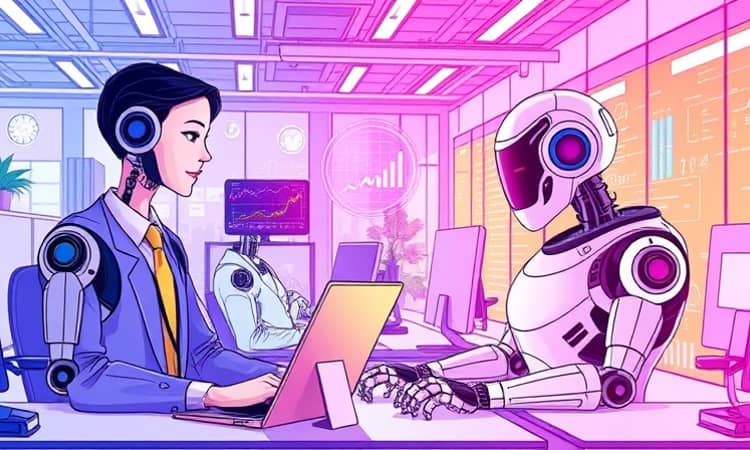
Automation and artificial intelligence are redefining the workplace at an unprecedented pace. From routine data entry to strategic analysis, new technologies promise both great opportunity and significant disruption. This article explores the scale of impact, productivity gains, sectoral shifts, wage dynamics, and the practical steps workers, firms, and policymakers can take to navigate this transformation.
Understanding the Scale of Automation Potential
Advances in machine learning, robotics, and generative AI have created a landscape where a vast share of tasks could be automated. However, distinguishing between technical potential vs actual adoption is crucial: the capacity to automate does not immediately translate into job losses.
Key estimates highlight the scope:
- Current technologies could automate about 57% of U.S. work hours, according to McKinsey.
- By 2030, 30% of U.S. jobs may be fully automated, and 60% will see significant task-level changes, per National University research.
- Globally, some 300 million jobs—9.1% of all roles—could be “lost to AI” as tasks become automated.
Longer-term projections suggest up to 50% of jobs in advanced economies could be automated by 2045, depending on adoption speed and regulation. Yet the Yale Budget Lab finds that structural change still unfolds over years, not months, with accelerated churn but within historical bounds.
Productivity, Growth, and Macroeconomic Effects
Automation is strongly associated with higher productivity and economic expansion. Goldman Sachs economists estimate that generative AI could raise labor productivity by about 15% in advanced economies once fully adopted. That boost could translate into substantial GDP gains but also a temporary spike in unemployment—an estimated 0.5 percentage point rise above trend during the transition.
McKinsey’s 2025 report on AI agents and robots forecasts:
- AI-powered tools could generate $2.9 trillion in U.S. economic value per year by 2030.
- The full technical potential of AI automation may reach $6.4 trillion annually in the U.S. and $28.7 trillion globally.
Firm-level studies reinforce these findings. MIT Sloan research (2014–2023) shows that AI-intensive companies experience 6% higher employment growth and 9.5% higher sales growth over five years than peers. PwC’s AI Jobs Barometer finds industries exposed to AI enjoy roughly three times higher revenue per employee growth and wages rising twice as fast as in low-exposure sectors.
These patterns confirm that automation is strongly pro-productivity and pro-growth, but the distribution of benefits remains uneven.
Sectoral and Occupational Winners and Losers
The effects of automation vary dramatically across roles and industries. Some occupations face steep declines, while others thrive through augmentation.
High-Risk vs. Growth-Oriented Roles
- High-risk roles: Bank tellers face a 15% decline, cashiers 11%, telemarketers and clerical positions follow closely.
- Growth sectors: Database administrators and architects are projected to grow by 8.2% and 10.8% respectively, as demand for data infrastructure surges.
- High-wage, information-intensive occupations often benefit from AI augmentation, allowing workers to focus on creative and strategic tasks.
Despite anxiety over job losses, net job creation remains positive. World Economic Forum projections estimate 92 million roles displaced by 2030, but 170 million new jobs created by macro trends, including AI, green technology, and demographic shifts.
MIT Sloan’s labor-market study finds that AI-exposed occupations did not experience overall job losses between 2014 and 2023, and even grew by 3% as productivity gains enabled firm expansion. Yet within firms, certain top-paying roles saw a 3.5% headcount reduction, highlighting localized displacement.
Wage Dynamics and Inequality
Automation’s effect on wages is complex. In AI-exposed industries, wages rise about twice as fast as in low-exposure sectors. However, gains are concentrated among workers with advanced skills, potentially widening income inequality.
Entry-level roles traditionally serving as career stepping-stones face disruption: nearly 50 million U.S. entry-level jobs are at risk from task automation. This shift can depress early-career wage growth and hamper experience accumulation, making the transition to higher-skilled roles more challenging.
Preparing for the Future: Skills, Education, and Policy
Adapting to an automated economy requires coordinated action by workers, firms, and governments. Key strategies include:
- Continuous upskilling and reskilling: Embrace lifelong learning in digital literacy, data analysis, and AI collaboration tools.
- Firm-led training investments: Develop internal programs that enable employees to transition into AI-complementary roles.
- Policy frameworks: Implement portable benefits, wage insurance, and targeted subsidies for training programs.
Educational institutions must partner with industry to design curricula that align with evolving employer needs. Policymakers can encourage flexible pathways, such as micro-credentials, apprenticeships, and tax incentives for on-the-job training.
Shaping an Inclusive Automation Agenda
Automation need not be a harbinger of inequality. With foresight and collaboration, society can harness AI’s power to create higher-quality jobs and distribute gains more equitably. Key principles include:
• Ensuring equitable access to lifelong learning, especially in underserved communities.
• Designing inclusive safety nets that support transitions without disincentivizing work.
• Promoting transparent adoption practices that involve workers in technology decisions.
Conclusion: Embracing Change and Opportunity
The future of work will be shaped by how effectively we manage the transition to an automated economy. While the scale of change is significant, history shows that technology can drive productivity, innovation, and prosperity when guided by thoughtful policies and invested stakeholders.
By focusing on skills development, policy innovation, and inclusive growth, we can ensure that automation lifts productivity while expanding opportunity for all. The path ahead demands resilience, creativity, and collective action—but the potential rewards are immense.
Now is the moment to shape a future where humans and machines collaborate to achieve unprecedented levels of progress and well-being.