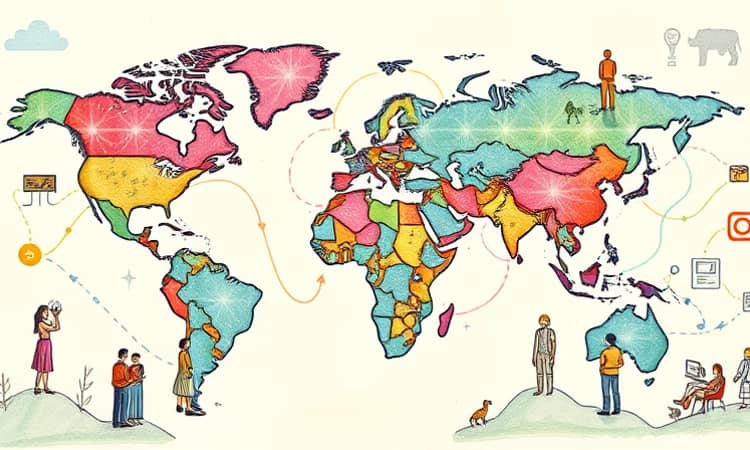
Globalization is entering a new era—one defined by fragmentation, technological leaps, and renewed regional ties. Far from disappearing, cross-border exchange is being rebuilt on adaptive, resilient foundations.
In this age of shifting power balances and digital acceleration, understanding emerging trends can help businesses, policymakers, and individuals thrive in a more fragmented, multipolar, yet hyperconnected world.
From Hyper-globalization to Reimagined Connections
Over the past four decades, globalization delivered enormous gains: trade grew exponentially, supply chains spanned continents, and economies became deeply interlinked. Today, a systemic shift is underway. Instead of a single, integrated system, we face multiple centers of influence. Yet, trade is far from collapsing—it reached a record $32 trillion in 2023.
This new paradigm can be seen as a grand evolution rather than a reversal. Economic ties will still bind nations, but they will be forged in regional blocs, digital platforms, and strategic alliances. Understanding these reimagined connections is key to staying ahead.
Key Geopolitical and Geo-economic Shifts
The global stage is increasingly shaped by strategic rivalries, protectionist policies, and resource competitions. The U.S.–China rivalry stands at the center, influencing everything from tech standards to security alliances.
- Weaponized interdependence dominates statecraft, with tariffs, sanctions, and export controls driving negotiations.
- Since January 2025, U.S. tariffs surged to an average of 18.2%, the highest since 1934, prompting nations to diversify trade partners.
- China’s exports to Europe rose by 6%, and to Mexico and Canada by 25%, as companies seek tariff avoidance.
- Cumulative costs to the global financial system could reach $5.7 trillion if fragmentation deepens.
In parallel, competition for critical minerals—essential for EVs, batteries, and renewables—fuels new investment patterns and strategic alliances. The scramble for resources highlights the blend of cooperation and contention defining modern globalization.
Economic and Business Megatrends
Businesses must navigate a landscape marked by diverging rules, geopolitical risk, and evolving consumer expectations. Four megatrends stand out:
- Disruption of global supply chains through nearshoring, friend-shoring, and “just-in-case” inventory models.
- Proliferation of conflicting regulations in data, trade, ESG, and taxation, raising compliance costs.
- Heightened pressure for corporate ethical stances, as consumers demand accountability and values alignment.
- Realignment of capital flows toward security-critical sectors like AI, green tech, and semiconductors.
This environment makes globalization harder but unavoidable. Firms that embrace agility—redesigning processes, diversifying suppliers, and integrating ESG into core strategy—will capture growth.
Technology and Digital Globalization
Technology, especially AI and digital platforms, is the turbocharger of the new globalization. It enables cross-border collaboration at unprecedented speed, but also introduces challenges around sovereignty and security.
AI-driven Transformation
AI is reshaping operations, supply chains, and customer engagement. According to the World Economic Forum, accelerating AI is one of seven major global shifts in 2025. In consumer industries, AI-driven processes can cut content production costs by up to 60% while boosting conversion rates by 20%.
Enterprises adopting AI frequently report up to 40% productivity gains. Amazon’s use of 750,000 robots alongside 1.5 million employees exemplifies the scale of human-machine collaboration in logistics and e-commerce.
Digital Sovereignty and Cybersecurity
As nations assert control over data, companies must comply with a patchwork of regulations like the EU’s GDPR and India’s Digital Personal Data Protection Act. Operating in this fragmented internet environment demands robust data governance and compliance frameworks.
At the same time, cyber threats intensify. Deepfake fraud attempts occur every second, eroding trust and highlighting the need for resilient security architectures.
Cross-border Digital Commerce
Online platforms, digital payments, and streamlined logistics are democratizing global trade. Cross-border e-commerce is on track to reach $7.9 trillion by 2030, opening opportunities for SMEs to compete internationally.
Hyper-localized experiences—tailored digital storefronts, regional fulfillment centers, and culturally adapted marketing—are becoming essential strategies for capturing diverse markets.
Economic Outlook: Balancing Growth and Risk
Global economic growth remains moderate, with persistent headwinds like weak productivity, high debt, and geopolitical tensions. The IMF projects 3.3% growth in 2024, easing slightly to 3.2% in 2025 and 3.1% in 2026. Advanced economies will expand at around 1.7% in 2025, while emerging markets and developing economies may reach 4.2%.
For businesses and policymakers, these figures underscore the importance of resilience. Strategies that blend innovation, risk management, and sustainability will be critical for thriving amid volatility.
Strategies for Thriving in Reimagined Globalization
To navigate this evolving landscape, stakeholders can adopt the following approach:
- Embed flexibility: Design supply chains with regional alternatives and strategic inventories to absorb shocks.
- Invest in digital skills: Prioritize AI literacy, data analytics, and cybersecurity training to leverage technological advantages.
- Engage in multilateral coalitions: Join regional trade agreements and industry alliances to shape emerging rules.
Ultimately, the future of globalization is not predetermined. It will be written by those who recognize its new form: a patchwork of interwoven networks, driven by technology, powered by collaboration, and bounded by both political and environmental realities.
By embracing a mindset of continuous adaptation and strategic foresight, organizations and individuals can transform uncertainty into opportunity, forging lasting connections in a world reimagined.