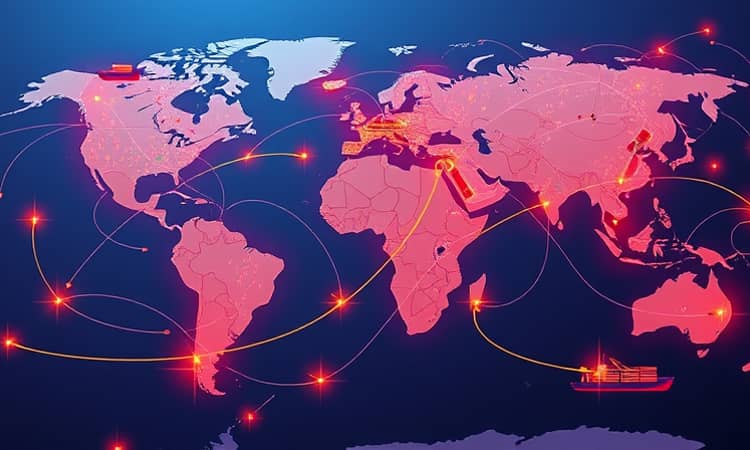
As global commerce evolves, companies must adapt to volatile markets, geopolitical tensions, and rapid technological advances. The future belongs to those who anticipate change and build resilient networks.
Understanding the Drivers of Change
The supply chain transformation today is propelled by complex, interrelated forces. Stakeholders must grasp these drivers to navigate uncertainty and seize strategic advantage.
First, US–China tech decoupling is recasting traditional trade lanes. Companies are diversifying sourcing toward Southeast Asia and India, reducing reliance on single-country suppliers. This trend continues to accelerate as firms pursue nearshoring, friendshoring, multishoring strategies to mitigate political risk.
Second, ongoing conflicts and chokepoints—from the Red Sea disruptions to port strikes—have highlighted the fragility of long transit routes. Firms are moving toward redundant and regionalized networks to avoid disruptions and maintain customer service levels.
Third, inflation and labor shortages are driving a granular focus on cost-to-serve analysis by product, customer, and channel. Companies invest in automation to offset rising wages and overcome warehousing and transport labor gaps.
Fourth, tightening regulations on small parcels, ESG mandates, and Scope 3 emissions are urging companies to adopt circular economy practices, including recycling, returns management, and remanufacturing. These measures not only reduce environmental impact but can also enhance brand reputation.
Finally, consumer expectations for faster delivery, higher customization, and ethical sourcing are reshaping last-mile and inventory strategies. The e-commerce boom demands agile, digitally enabled supply chains.
Reconfiguring Global Networks for Resilience
In response to these drivers, companies are redesigning their supply chains to balance cost, speed, and risk. The paradigm is shifting from pure globalization toward a “multi-localization” model.
Multishoring, which combines near-, on- and far-shoring within a unified network, allows firms to flex capacity across regions. For instance, Chinese imports into the US dropped 8% between 2017 and 2023, while imports from Southeast Asia, Mexico, Canada, and India rose significantly.
Meanwhile, China is pursuing a “reverse globalization” strategy, expanding outbound FDI from $8 billion in 2004 to $225.7 billion in 2023. About 70% of these investments are driven by SMEs establishing production and sales hubs in North America, Southeast Asia, and the Middle East. Core R&D and management often remain in China, while assembly plants operate closer to end markets.
New trade corridors are emerging as well. Projects like the Port of Chancay in Peru promise to cut Asia–Latin America shipping times by over ten days, bypassing traditional gateways and offering alternative capacity for Asia–Pacific exporters.
At sea, carrier alliances now control roughly 60% of global container capacity. By consolidating calls on primary routes, they can reduce transit times but also risk marginalizing secondary ports. Shippers must weigh cost savings against potential service disruptions when selecting carriers and routes.
Technology Powering the Next Wave
Technology is the catalyst enabling supply chain reinvention. AI, advanced analytics, automation, and robotics are unlocking new levels of visibility, efficiency, and flexibility.
By 2025, over 50% of the global supply chain industry will have adopted AI tools for planning, forecasting, and dynamic safety stock management. Generative AI is also being deployed to simulate network disruptions and recommend real-time rerouting solutions.
In manufacturing and warehousing, automation adoption is rising rapidly. Although only about 25% of warehouses today employ some form of robotics, that share is expected to double as firms seek speed, accuracy, and labor savings. China remains the largest industrial robot market, installing over 276,300 robots in 2023, yet global density still lags behind South Korea and Singapore, highlighting room for further growth.
The shift to manufacturer-to-consumer (M2C) models is another transformative trend. Direct cross-border e-commerce exports reached $299.5 billion in 2024, and platforms like Amazon, Temu, and others facilitate one-week order-to-delivery cycles from Asia to Europe. By eliminating intermediaries, manufacturers gain real-time demand insight and can run low-volume, high-frequency production runs that align with actual sales.
Implications for Businesses and Policy
As supply chains reshape, stakeholders must adapt their strategies and policies to remain competitive and compliant.
- Businesses should develop multi-scenario network models that incorporate geopolitical risk, natural disasters, and labor market volatility.
- Investing in modular, digital supply chain platforms will provide the agility needed for rapid reconfiguration.
- Collaboration across the ecosystem—shippers, carriers, technology providers, and regulators—will be critical to balancing efficiency, resilience, and sustainability.
Policymakers, meanwhile, need to calibrate trade measures, ESG standards, and investment incentives to encourage responsible supply chain diversification without stifling innovation. Striking the right balance between security and openness will determine which regions emerge as the winners or losers in the coming decade.
Companies that proactively embrace these changes—rebalancing networks, deploying cutting-edge technologies, and adopting circular practices—will not only withstand shocks but also capture growth opportunities in emerging markets. The path ahead demands foresight, collaboration, and continuous reinvention.
Ultimately, the next phase of global commerce will be defined by those who see volatility as opportunity, who invest in both people and machines, and who build supply chains that are as dynamic as the world they serve.