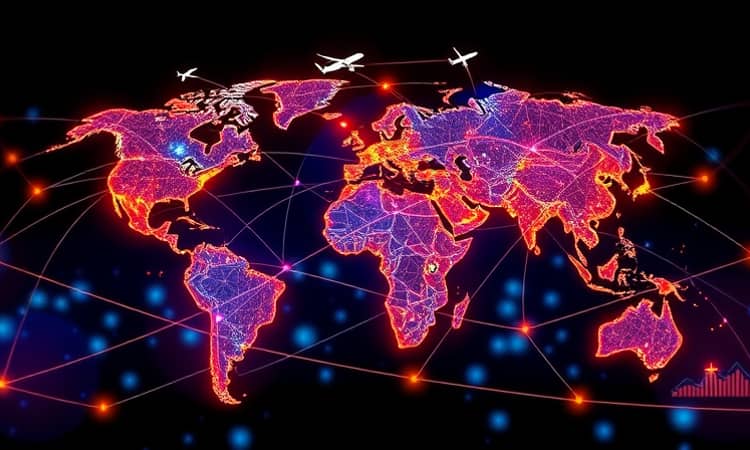
In today’s world, our lives and livelihoods are bound by an intricate tapestry of connections. From the movement of goods across oceans to the flow of data through undersea cables, we exist within an ecosystem of mutual dependence. This deeply interconnected global system shapes not only national policies but also everyday choices, opportunities, and challenges.
A World in Slow Motion: Growth in an Interconnected Age
Once roaring at an average pace of 4.4% before the 2008–09 crisis, global growth has tempered in recent years. The latest projections from UNCTAD foresee 2.6% GDP growth in both 2025 and 2026, down from 2.9% in 2024 and below the pre-pandemic 3% trend.
Major economies mirror this slowdown. The United States is expected to expand at 1.8% in 2025 and 1.5% in 2026, while China’s growth is forecast at 5% in 2025, easing to 4.6% in 2026, compared to its pre-pandemic average near 6.7%. Such figures highlight how a slower, more fragile growth environment is shaped by trade, finance, and technology spillovers, underscoring our mutual dependence.
Trade: The Circulatory System of Growth
Global trade in goods soared past USD 24 trillion in 2024. Early data for 2025 show about a 4% increase, though once temporary boosts are stripped out, true underlying growth hovers around 2.5–3%. Despite tariffs, geopolitical tensions, and policy shifts, trade remains resilient though volatile and on track to surpass last year’s record.
Behind these aggregates lie two distinct flows: goods and services. On a rolling annual basis, goods trade grew about 5%, led by electronics and automotive sectors—particularly hybrid and electric vehicles—while services trade increased around 6%, fueled by travel, ICT, and other business services.
- Manufacturing exports: electronics, automotive, renewable energy components
- Services exports: tourism, cloud computing, financial and professional services
This shift signals a broader transformation from a goods-centric connectivity to a services- and knowledge-centric economy, where digital platforms and intellectual property travel as fast as containers.
Trade imbalances are also in flux. In Q2 2025, global goods imbalances narrowed, largely driven by policy adjustments in the United States. China’s overall surplus dipped slightly, while the EU saw its surplus contract as well. Such shifts reflect not only market forces but also deliberate tariff policies, currency moves, and industrial strategies.
A close look at the United States illustrates these dynamics. In August 2025, exports reached USD 280.8 billion, imports fell to USD 340.4 billion, and the monthly deficit shrank to USD 59.6 billion—a 23.8% drop from July. Yet on a year-to-date basis through August, the deficit had widened by USD 142.5 billion (+25%), as imports grew faster than exports. These numbers paint a vivid picture of how a single nation’s trade flows reflect broader global currents.
Finance: The Invisible Scaffolding
Trade cannot occur without money moving underneath the surface. More than 90% of global trade depends on some form of finance—trade credit, letters of credit, supply-chain finance, and related instruments. This invisible scaffolding of trade facilitates cross-border transactions and risk sharing, yet also introduces vulnerabilities tied to interest rates, banking stress, and currency volatility.
- Trade credit and letters of credit: ensure exporters receive payment and importers secure goods.
- Supply-chain finance: optimizes working capital but can amplify volatility in crises.
- Regulatory risk and policy unpredictability: sudden rate hikes or sanctions disrupt flows.
Recent UNCTAD analyses link tightening financial conditions to the global growth slowdown, warning that geopolitical instability and unpredictable policy shifts—especially in energy and food markets—could trigger sharper disruptions.
Digital Connectivity: The Nervous System
Just as nerves carry signals in living organisms, digital networks transmit information essential for modern commerce. By 2025, approximately 6 billion people will be online, representing about 67.1% of humanity. China leads with roughly 1.1 billion users, followed by India at 881 million and the United States at 311 million.
Some regions approach universal access: Northern Europe exceeds 97% penetration, with North America and much of the Americas above 80%. Yet this progress coexists with stark exclusion. Over 2.5 billion people still lack internet access, despite mobile network coverage reaching 92% of the global population. In low-income countries, only 14% of rural residents are online, just over one-third of the urban rate. This two-tier connected world leaves entire communities at risk of digital marginalization.
- Quality & Availability: broadband speeds and coverage gaps
- Affordability & Devices: cost of access and suitable hardware
- Skills & Security: digital literacy and trust in online systems
These dimensions define “universal and meaningful connectivity.” Closing digital divides can unlock new economic opportunities, improve education and healthcare delivery, and foster inclusive growth.
Practical Steps Forward: Navigating the Interwoven Web
Understanding the threads that bind our world is the first step; weaving them into resilient, inclusive systems is the next. Whether you are an individual, a business leader, or a policymaker, concrete actions can help you thrive within the interwoven web of global economies.
- Invest in digital literacy and infrastructure: support community networks, online training, and affordable devices.
- Diversify supply chains and trade partnerships: build flexibility to manage shocks and capitalize on emerging markets.
- Strengthen cross-border financial regulations: encourage transparency, foster collaboration among regulatory bodies, and develop contingency planning.
For individuals, upskilling in digital tools and cross-cultural communication can open doors in remote work and global marketplaces. Businesses should integrate sustainability and risk management into strategy, leveraging technology to enhance transparency. Policymakers must prioritize inclusive digital policies and stable financial frameworks, ensuring that no region is left behind.
Conclusion: Embracing Connectivity with Purpose
Our global ecosystem—shaped by trade routes, financial pathways, and digital networks—offers unprecedented possibilities. Yet it also demands collective vigilance and creativity. By recognizing how our choices ripple through the web of economies, we can foster collective resilience and shared prosperity. Let us embrace the transformative power of global connectivity to build a future where growth is sustainable, inclusive, and humane.