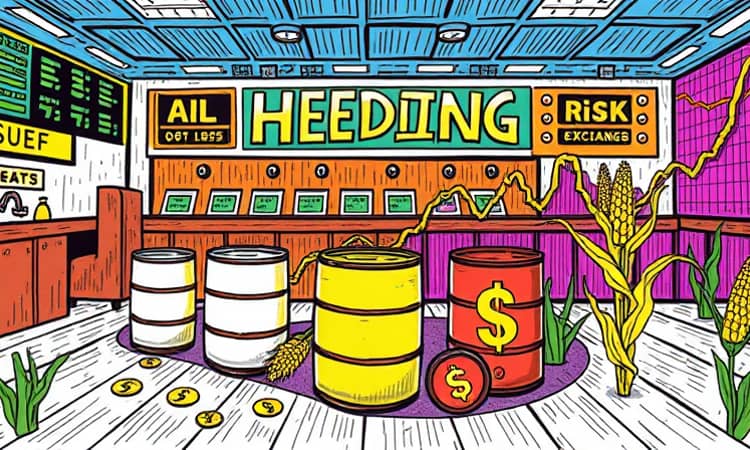
In today's fast-paced markets, mastering risk management can spell the difference between stability and volatility for businesses and investors alike.
With derivatives, you can lock in a price today for future transactions, shielding yourself from unpredictable swings.
Understanding Derivatives and Hedging Basics
A derivative is a financial instrument whose value depends on an underlying asset such as commodities, equities, interest rates, currencies, or indices. By taking a position in a derivative, a market participant can prevent adverse price movements in the underlying exposure.
Hedging means entering a transaction that offsets an existing or anticipated risk, rather than seeking pure profit. Corporations, producers, and investors often use forwards and futures to secure margins and ensure predictable cash flows.
Why Hedge? Main Risk Types
Hedging with forwards or futures addresses several core risks that organizations face:
- Price risk for commodities like oil, metals, and grains.
- Currency risk for importers, exporters, and multinational corporations.
- Interest rate risk for borrowers and yield-sensitive investors.
- Equity or market risk for portfolio managers and fund managers.
Hedgers differ from speculators: while speculators bet on price moves for profit, hedgers aim to neutralize exposures linked to their core operations.
Forward Contracts: Mechanisms and Use Cases
A forward contract is an over-the-counter OTC forward agreement tailored between two parties to buy or sell an asset at a specified price on a future date. These contracts feature fully customized sizes, maturities, settlement methods, and underlying quality specifications.
Key characteristics include no daily cash flow until maturity and direct counterparty credit risk, since forwards are not cleared through a central exchange.
Generic forward structure:
Parties agree on:
• Forward price (F0)
• Quantity (e.g., 1 million barrels)
• Maturity date (e.g., five months ahead)
• Settlement type (physical delivery or cash settlement)
At maturity, the long position receives ST – F0 (if positive), and the short receives F0 – ST.
Oil Producer Example: A company expects 1 million barrels of oil in five months. Worried about a price drop, it sells a forward at $70/barrel. If the spot falls to $60, the firm still nets $70 via the forward payoff, maintaining its effective sale price.
This classic short hedge locks in revenues and stabilizes earnings regardless of market swings.
Corporates also use forwards to manage FX risk. Consider these common FX hedging strategies:
- Specific invoice hedge: Match a single forward to a known future payment.
- Rolling hedge: Stagger multiple forwards for recurring cash flows.
- Layered forwards: Spread hedges across different maturities for flexibility.
Comparing Forwards and Futures
While both instruments lock in future prices, key contrasts shape their suitability:
Futures Contracts: Mechanics and Practical Examples
A futures contract is a standardized exchange-traded futures contracts specifying price, quantity, and delivery month. Traded through venues like CME Group, futures require posting initial margin and variation margin and undergo daily mark-to-market.
Most hedges are closed out before delivery by taking the opposite position, thus avoiding physical exchange.
Types of futures hedges:
- Short hedge: Sell futures when you own or will own an asset, guarding against price declines.
- Long hedge: Buy futures when you will need an asset, locking in purchase costs.
Corn Farmer Example: A farmer expecting to sell 200,000 bushels in January sells 20 corn futures contracts at $3.50/bushel. If futures rise to $3.75 at harvest, the gain on futures offsets lower spot receipts, keeping the effective sale price near $3.50.
However, hedge effectiveness depends on basis risk. Basis at time t is St – Ft. If basis changes unexpectedly, the net price can deviate from the original lock-in level.
Understanding and monitoring basis risk impacting hedge effectiveness is essential for precise risk management and avoiding residual exposure.
Key Takeaways and Best Practices
Hedging with forwards and futures offers powerful tools to stabilize revenues, manage budgets, and protect financial positions. Corporates should align instrument choice with needs: OTC customization for bespoke exposures or exchange-traded liquidity for transparent, margin-backed contracts.
Best practices include rigorous counterparty assessment for forwards, diligent margin monitoring for futures, and continuous review of basis relationships. By weaving these strategies into financial planning, organizations can confidently navigate market volatility and secure predictable outcomes.