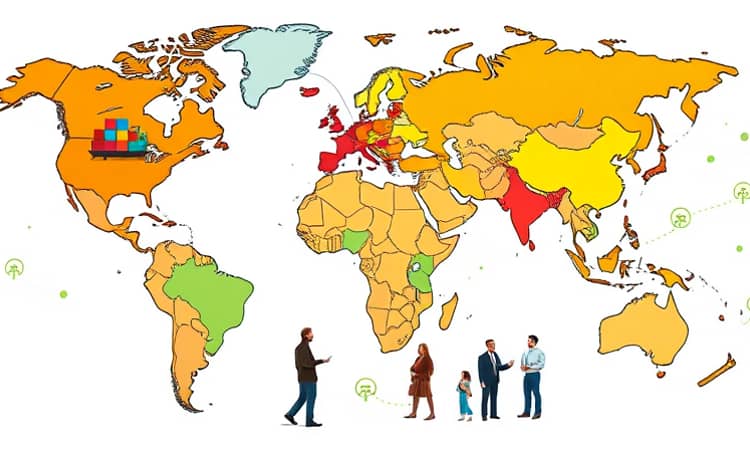
In a world buffeted by geopolitical tensions and economic shocks, global trade stands at a crossroads. Momentum has not collapsed, but forecasts are turning downward, calling for bold action. This article explores the journey from protectionism to a more resilient, diversified, and sustainable future.
The Era of Rising Protectionism
Since the mid-2010s, governments have increasingly resorted to trade barriers and subsidies, reshaping the rules that once underpinned cross-border commerce. Global Trade Alert data shows harmful interventions ballooned from around 600 measures in 2017 to over 3,000 per year from 2022 through 2024, with similar levels expected in 2025.
At the same time, the Trade Policy Uncertainty (TPU) index has soared. From an average of 85 between 2015 and 2024, it climbed to 900 in 2025. Businesses and investors are grappling with persistent policy uncertainty and volatility that disrupt planning and investment.
- The United States applied a sweeping package of tariffs in early 2025, affecting imports across multiple sectors.
- China responded with its own duties and export restrictions on critical minerals vital for green technology.
- Export controls on advanced semiconductors and rare earths have become tools of geoeconomic confrontation.
These measures are not isolated events but part of a broader trend identified by the World Economic Forum, which ranks geoeconomic confrontation among the top global risks today.
Structural Shifts Reshaping Global Commerce
Amid protectionist pressures, companies and policymakers are forging new approaches to maintain supply chain integrity and market access. This evolution spans regional supply chains and friend-shoring, the rise of services and digital trade, and strategic competition over critical minerals.
- Regionalization: Firms are relocating production closer to consumption hubs to limit border risks.
- Digital platforms: E-commerce and digital services reduce dependence on physical logistics.
- Critical minerals: Nations are securing supply lines for lithium, cobalt, and rare earths.
For example, China’s export volumes to regions beyond the United States rose sharply in Q2 2025, offsetting a decline in bilateral shipments to the U.S. This diversification highlights how market agility can soften the blow of unilateral barriers.
Meanwhile, service exports continue to grow, buoyed by digital technologies that transcend traditional tariffs. Companies are adopting cloud-based solutions and fintech platforms to reach customers seamlessly, signaling a shift towards an interconnected, technology-driven trade model.
Uneven Impacts Across Economies and Sectors
While some economies adapt swiftly, others face daunting challenges. Advanced nations exporting high-value, low-volume goods can front-load shipments or reroute to alternative markets. In contrast, least developed countries (LDCs) exporting bulk commodities lack such flexibility and suffer disproportionately when measures tighten.
Supply chain disruptions—from Panama Canal water shortages to port strikes—compound the effects of policy barriers. Firms holding excess inventory or investing in new logistics routes face higher operational costs, deterring capital expenditure and innovation.
- Advanced economies leverage financial markets to hedge exchange rate risks and secure credit.
- LDCs struggle with infrastructure gaps, limited financing, and shrinking market access.
- Industry disparities emerge: Manufacturing endures physical constraints, while digital services can pivot rapidly.
This uneven landscape underscores the need for tailored strategies. Small exporters can pursue e-commerce hubs and niche markets, while larger firms might invest in multiple production sites to balance risk.
Charting a Path to Progress
Despite headwinds, a forward-looking agenda is taking shape, centered on resilience, sustainable growth, and reform. Stakeholders are rallying around four pillars: resilience, diversification, green and digital integration, and rule-based cooperation.
Resilience and sustainability go hand in hand. By embedding environmental standards into production processes and embracing renewable energy sources, companies not only mitigate regulatory risks but also tap into growing consumer demand for eco-friendly products.
Practical steps for businesses and policymakers include:
- Establishing resilience and strategic diversification through multi-region supply networks.
- Accelerating digital transformation with blockchain for traceability and AI for demand forecasting.
- Adopting circular economy principles to reduce waste and improve resource efficiency.
- Engaging in multilateral dialogues to modernize global trade rules, focusing on digital services and sustainable development.
By pursuing these measures, firms can turn uncertainty into opportunity. For instance, an electronics manufacturer reduced lead times by 30% after implementing a hybrid nearshore/offshore model and leveraging digital twins to simulate supply chain scenarios.
On the policy front, regional trade agreements are being revamped to include chapters on digital trade, environmental protection, and investment facilitation. Such reforms can create a more predictable environment, helping firms make long-term decisions with confidence.
Conclusion: Embracing an Inclusive Future
The shift from protectionism to progress demands collaboration between governments, businesses, and civil society. By investing in infrastructure, championing transparent regulations, and fostering innovation, stakeholders can build an inclusive and sustainable trade landscape that benefits communities worldwide.
As global challenges evolve, so too must our strategies. Embracing diversity in supply chains, advancing green technologies, and reforming global rules are not just ideals—they are practical imperatives for a thriving, interconnected economy. The path ahead may be complex, but with vision and cooperation, progress is within reach.