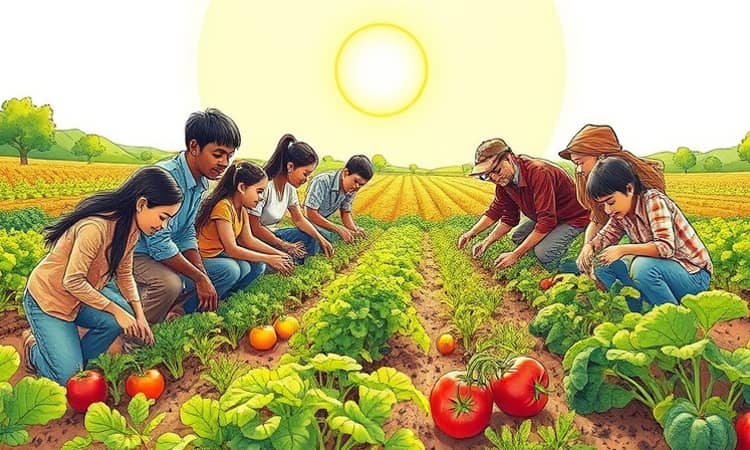
As we look to the horizon of tomorrow, ensuring that every individual can live free from hunger is more than a policy goal: it is a moral imperative. Food security is at the heart of health, education, and social stability, shaping the future of communities around the world. Today’s young people inherit both the crisis and the responsibility to transform it into an opportunity for lasting change.
Framing the Principle of Food Security
According to the FAO/UN definition, food security exists when all people, at all times have adequate access to sustenance that fuels an active and healthy life. This concept is underpinned by four interlinked pillars that guide global action and local policy.
- Availability – ensuring enough food is produced and supplied;
- Access – guaranteeing that food is affordable and reachable;
- Utilization – promoting safe, nutritious consumption and proper care;
- Stability – maintaining these gains consistently over time.
Current Trends and Alarming Statistics
In 2024, an estimated 673 million people experienced hunger, representing 8.2% of the global population. While this figure marks a slight decline from previous years, it remains higher than pre-pandemic levels. Acute crises, driven by conflict and climate shocks, have pushed a record 295.3 million people facing high levels of acute food insecurity in 2024 alone.
Between 2019 and 2024, moderate or severe food insecurity affected 28% of the world’s population—nearly 2.3 billion individuals. Despite small improvements, this is still 335 million more people than in 2019. Famine conditions, once rare, have reemerged in regions such as Sudan and Gaza, leaving over 770,000 people in life-threatening situations.
These numbers tell a story of persistent injustice: while some regions rebound, others slide deeper into vulnerability. The challenge of chronic undernourishment and sudden acute shortages coexists, demanding a dual response that addresses both long-term deficits and immediate crises.
Drivers of the Food Crisis
The roots of global hunger are complex and interwoven. Wars and civil conflicts displace millions, disrupting farming cycles and eroding markets. Climate change unleashes more frequent droughts, floods, and heatwaves, devastating harvests and livestock. Economic turmoil, marked by soaring food price inflation and stalled incomes, can turn basic staples into luxury goods.
- Conflict and displacement undermining rural livelihoods;
- Climate shocks disrupting production systems;
- Economic instability and food price inflation;
- Pandemic-related supply chain breakdowns.
Underlying these factors is the rise of the “double burden” within households: the co-existence of undernutrition and obesity driven by world reliance on cheap, calorie-dense but nutrient-poor food. This paradox highlights the urgent need to shift towards a more equitable and sustainable food system.
Regional Disparities and Vulnerable Groups
No corner of the globe is immune, yet the severity of hunger varies widely. Sub-Saharan Africa carries a disproportionate share of the burden, with nearly 27% of its population facing chronic food insecurity. In Western Asia, protracted conflicts coupled with economic instability have left millions teetering on the edge of famine.
Children bear the heaviest cost. Over 190 million children under five suffer from undernutrition, compromising their physical and cognitive development and limiting their future potential. Women, displaced families, and indigenous communities also rank among the most at risk, often lacking both resources and representation in decision-making processes.
Solutions and Future Scenarios
Confronting this crisis demands both bold vision and meticulous action. Emergency responses—food aid, cash transfers, and nutritional therapy—are critical to protect lives today. Yet without structural change, relief efforts merely put a bandage on deeper wounds. We must invest in resilience, empowering communities to withstand future shocks.
- Strengthening sustainable agriculture and resilience through climate-smart farming;
- Promoting diverse, nutritious diet at scale with local value chains;
- Improving social protection and safety nets targeted to the poorest;
- Enhancing international cooperation and funding to bridge the resource gap;
- Encouraging technological innovation in storage, logistics, and data.
Policies must prioritize smallholder farmers, who produce most of the world’s food yet receive a fraction of global subsidies. Land rights, access to credit, and agricultural extension services enable families to move from mere survival to dignified, prosperous livelihoods. Meanwhile, reducing food loss and waste can recover nearly a quarter of the calories currently lost between farm and fork.
Looking ahead, projections offer both caution and hope. A combination of rising incomes and easing food prices could lift millions out of hunger by 2030. Yet without targeted support for the regions and communities still lagging, progress will remain uneven. Our collective challenge is to ensure that no one is left behind.
As the next generation steps forward, the time to act is now. By aligning global ambition with local action, embracing innovation, and centering human dignity, we can transform our food system from a source of crisis into a foundation of opportunity. Every child fed, every community empowered, brings us closer to a world where hunger is not a legacy but a lesson we have overcome together.