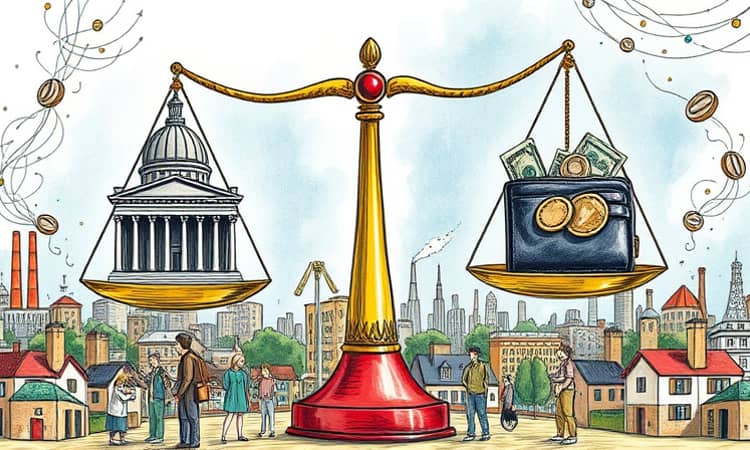
Every day, government decisions ripple through our bank accounts, price tags, and savings goals. Understanding fiscal policy empowers you to see how taxes, spending, and borrowing directly affect your financial well-being.
Understanding Fiscal Policy Basics
Fiscal policy refers to government choices on tax collection, spending programs, and borrowing to steer overall economic activity. As a central tool of macroeconomic management, it operates alongside monetary policy—interest rates and money supply—to achieve growth, employment, and price stability.
Key macro goals include:
- Economic growth
- Full employment
- Price stability (inflation control)
- Income distribution and social objectives
Below is a concise comparison of fiscal and monetary policy.
Breaking Down the Components of Fiscal Policy
Fiscal policy rests on three pillars: government spending, taxation, and borrowing. Each plays a distinct role in shaping economic outcomes.
- Government spending: Purchases of goods and services (teachers’ salaries, road construction), transfer payments (Social Security, unemployment benefits), and public investments (infrastructure, R&D).
- Taxation: Personal income, corporate, payroll, sales/VAT, property, and excise taxes. Structure matters
- Borrowing and public debt: Deficits arise when spending exceeds revenue; the government issues bonds, creating national debt. Interest costs on that debt become a significant recurring expense.
Additional legal distinctions divide spending into mandatory (entitlements), discretionary (annual appropriations), and supplemental (emergency or stimulus) categories.
Expansionary vs. Contractionary Approaches
Fiscal strategies adapt to economic conditions. In a downturn, higher government spending and tax cuts characterize expansionary policy—boosting demand, creating jobs, and supporting incomes.
Common examples include stimulus checks, extended unemployment insurance, and large infrastructure packages. Conversely, when inflation surges or debt rises, governments pursue contractionary measures—spending reductions, tax hikes, or both—to shrink deficits and cool overheating economies.
Implementation: From Budget Proposal to Execution
In the U.S., the federal budget process begins with the executive branch’s proposal, followed by legislative authorization and appropriation, culminating in agency execution. Political trade-offs shape every tax increase and spending decision.
- Main revenue sources: individual and corporate income taxes, payroll taxes, excise taxes, and various fees.
- Major spending categories: entitlements (Social Security, Medicare, Medicaid), national defense, domestic discretionary programs (education, transportation), and net interest on the national debt.
Notably, in FY 2024, net interest payments exceed national defense spending, underscoring the growing burden of servicing debt. Over half of every federal tax dollar now funds entitlement programs.
Key Numbers: Putting Fiscal Flows into Household Terms
Macro figures can feel abstract. Analysts often translate totals into per-household measures to illustrate scale:
- The federal government controls nearly one-quarter of every dollar earned—about $52,000 per household annually in spending.
- National debt stands at over $260,000 per U.S. household.
- Annual borrowing equals roughly $15,000 per household, influencing interest rates and inflation.
- U.S. personal saving reached $1.09 trillion in September 2025, with a 4.7% saving rate—highlighting household resilience.
Effects on Growth, Jobs, and Prices
In the short run, government outlays can swiftly boost demand, output, and employment through fiscal multipliers. Research shows $1 of federal spending raises GDP by $0.6–$1.0 under normal conditions and up to $2.0 when interest rates are low.
At state and local levels, every $1 of federal funding can add $1.3–$2.0 to local GDP and support one job per $50,000 spent. Multipliers peak during recessions when resources lie idle.
Program design matters: direct transfers to credit-constrained households and relief to state budgets often deliver faster, larger economic benefits than long-term infrastructure projects.
Long-Run Considerations and Trade-Offs
Persistent high spending can crowd out private investment by reducing corporate profits or driving up interest rates as debt rises. A 1% GDP reduction in the public wage bill, for instance, can boost the investment/GDP ratio by 2.77 percentage points over five years.
When debt grows, interest costs compete with other budget priorities, potentially forcing cuts to critical services or tax hikes that affect households and businesses alike.
What It Means for Your Wallet
Fiscal policy translates directly into your flow of federal dollars per household: taxes subtract from take-home pay, while transfers and government investments influence job prospects and service quality.
Changes in tax rates shape labor supply, investment decisions, and consumption patterns. For families, understanding these dynamics clarifies why policy debates over rates, spending, and deficits matter in everyday life.
By following budget proposals, legislative debates, and economic indicators, you can anticipate shifts in tax bills, social benefits, and public investments—aligning personal finances and civic engagement.
Conclusion
Fiscal policy is more than abstract numbers; it’s a powerful force that shapes incomes, prices, jobs, and savings. By grasping how government spending, taxation, and borrowing interact, you gain insight into the economic landscape and your role within it.
Stay informed, question assumptions, and engage in public discourse. After all, the decisions made in budget halls resonate in every household, determining who benefits, who pays, and how prosperity is shared.