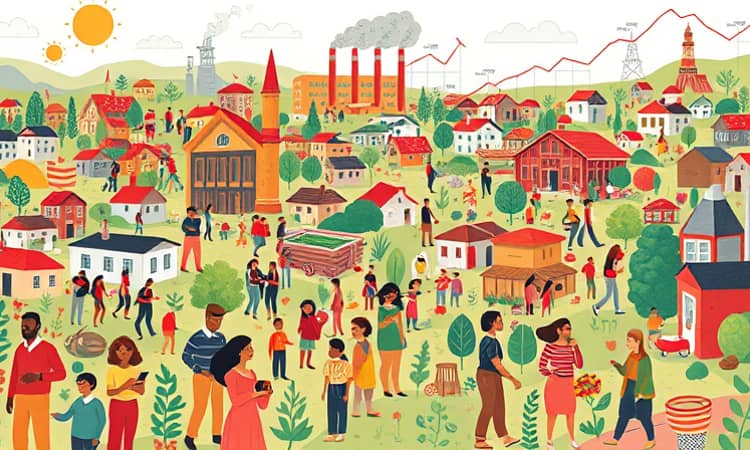
Demographic forces are reshaping economies, redefining consumer demand, and steering public investment. As birth rates fall, migration patterns evolve, and populations age, markets face profound transformation.
This article explores how transformative demographic forces—from global population slowdowns to regional migration—directly influence demand for housing, consumer goods, services, assets, and public finances.
Big-Picture Trends: Slower, Older, More Uneven
Across advanced economies, population growth has decelerated to historic lows. In the U.S., projections show a rise from 350 million in 2025 to 367 million by 2055, an annual rate of just 0.15–0.2%. This slow population growth rates scenario impacts everything from employment to retirement systems.
Simultaneously, aging populations elevate old-age dependency ratios, intensifying pressure on pension funds, healthcare spending, and household savings behavior as retirees draw down assets.
Meanwhile, demographic shifts diverge sharply across regions:
- Rapidly aging population in China: A shrinking workforce drives up wages and prompts manufacturers to relocate or automate.
- Expanding working-age population in India: A potential demographic dividend hinges on education, job creation, and infrastructure expansion.
- Surging labor-force potential across Africa: Young, growing cohorts represent vast future markets, yet require integration into global value chains.
These contrasts highlight how population structures define competitive advantages, sector growth prospects, and investment priorities worldwide.
Domestic Shifts: Urban, Suburban, and Rural Transformations
Within the U.S., 387 metropolitan areas gained nearly 3.2 million residents (1.1%) between 2023 and 2024, outpacing national growth. As urban centers absorb talent and capital, housing markets tighten and service demand intensifies.
Yet state-level patterns vary dramatically. Florida led with 3.37% growth, driven largely by Florida’s booming workforce influx, not just retirees. Net inflows of working-age adults reshape local labor markets and consumption habits.
Conversely, many rural counties rely on international arrivals to counteract natural population decline. In nonmetro areas, international migrants accounted for 48% of net gains, underscoring their role in Rural America’s international migration lifeline.
These internal migrations spur opportunities for real estate developers, retail entrepreneurs, and local governments tasked with bridging the infrastructure gap.
Immigration: The Engine of Labor-Force and Demand
Immigrants, making up roughly 15% of the U.S. population, constitute 19% of the labor force and contribute 18% of total output ($2.1 trillion in 2024 dollars). From 2000 to 2022, they accounted for nearly 75% of growth in the prime-age labor force (25–54).
Government analyses project that over the next decade, immigrants could add $7 trillion to the economy, boost GDP by $8.7 trillion, increase federal tax revenues by $1.2 trillion, and reduce deficits by $900 billion. Their participation expands the tax base, elevates consumer demand, and sustains public finances.
Policy shifts can materially alter these outcomes. Consider projected effects on 2025 GDP growth under different scenarios:
- Baseline restriction scenario impacts GDP: 0.81 percentage points below earlier projections.
- High interior deportation scenario impact: Reduces growth by 0.83 points in 2025 and 0.84 in 2027.
- No-interior-deportation scenario slightly raises GDP: Adds 0.14 points in 2025 compared to benchmark.
Even modest changes in immigration policy ripple through residential investment, consumer spending, and labor-market tightness, with minimal effect on inflation.
Macroeconomic Outlook: Slowing Growth and Aging
As population growth decelerates and societies age, potential GDP expansion faces new constraints. CBO projections anticipate U.S. population rising from 350 million in 2025 to 367 million by 2055 under current immigration assumptions.
However, revisions to immigration estimates may lower these figures, implying smaller labor-force growth and slower output expansion. “Breakeven” job creation—the monthly hires needed to stabilize unemployment—could fall below 100,000 as labor-force growth decelerates.
This dynamic underscores a paradox: historically low job gains may still signal a healthy market, yet long-term potential remains capped by demographic headwinds.
Strategies for Adapting and Thriving
For investors, businesses, and policymakers, demographic awareness is essential. Key actions include:
- Aligning real estate development with evolving consumer demand patterns in aging suburbs and growing metros.
- Investing in education and training to harness the expanding workforce potential of migrants and youth cohorts.
- Modernizing healthcare and retirement systems to manage rising old-age dependency ratios sustainably.
Local governments should optimize public infrastructure investments, from transit to broadband, ensuring capacity matches shifting population distributions. Financial institutions must tailor products for multigenerational households, while labor-market planners anticipate slower breakeven employment targets.
Embracing demographic realities offers an opportunity for innovation: senior-focused services, multicultural retail experiences, and smart-city solutions thrive in a world of diverse age and cultural segments.
Conclusion: Embracing the Demographic Dividend
Population shifts are not mere statistics; they drive economic narratives and market trajectories. By anticipating market-wide demographic transformation, stakeholders can allocate capital, design policy, and craft strategies that harness the full potential of evolving societies.
In a landscape defined by slower growth, aging populations, and migration, those who adapt will find resilient paths to prosperity. Demographics and dollars are inseparable forces—understanding their interplay is the first step toward a thriving future.